



Course Overview
Set within an industry steeped in tradition, the leather trade supports the pursuit of excellence in its traditional craft skills whilst also embracing innovation and technology. The leather craftsperson is a fundamental occupational role in the leather trade and in a sector that contributes in excess of £700 million to the British economy.
British leather and leather products have an international and iconic reputation and the continued success of the sector will depend on maintaining a skilled, well-trained workforce.
‘Leather craftsperson’ is a broad description of someone who either produces the leather or manufactures leather goods for a number of markets from sporting pursuits, such as equestrian, golf and cricket applications, to high-end retail luxury goods, such as handbags luggage and lifestyle accessories.
An employee in this occupation may work in a small enterprise producing or manufacturing specialist leather/leathergoods or in a wider factory setting as part of a production or manufacturing team producing to larger orders. They will be able to work just as effectively on their own or as part of a wider team. In both instances they will understand the impact of their role on those working around them.
The Standard is designed to give an overarching range of skills, knowledge and behaviours appropriate to both the production of leather and the manufacture of leather goods. The former involving taking raw skin and hides and converting them through chemical and mechanical processing, to produce leather ready for a variety of applications. The latter involving taking leather and forming a finished product from it, often involving processes such as stitching and cutting.
Regardless of which methods the employers’ use, leather craftspeople will know and understand the end-to-end process of how leather is produced and the manufacturing processes required to produce a final leathergoods product.
An employee in this occupation will be responsible for working efficiently and accurately to agreed product specifications and customer requirements, using both hand and machine skills, within agreed production deadlines and to the required quality standard. In their daily work they will report to line managers and supervisors and often will interact with production colleagues. Typical working pattern is Monday to Friday.
Typical day-to-day duties include:
- The production of leather (processing and finishing)
- Quality check materials and components for faults
- Leather cutting operations
- Skive materials (shaving/reducing weight)
- Preparation of materials ready for the next stage of production
- Ink / paint raw / cut leathers edge
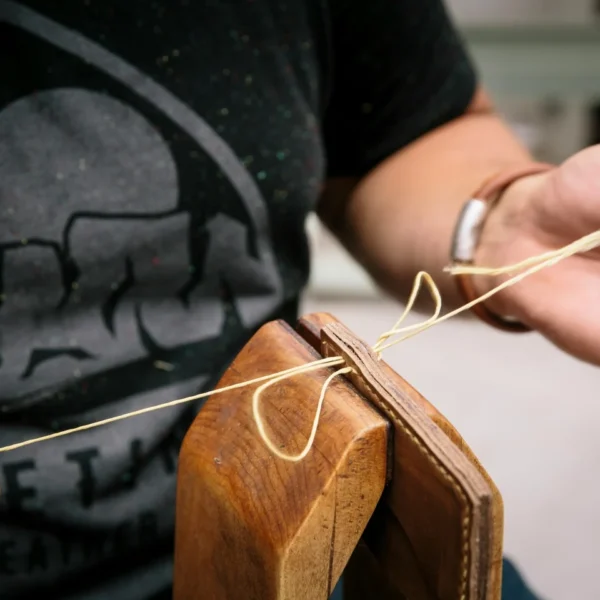
- Hand and machine sewing of leather components and assembly
- Examination of finished leather / leather product for quality
- Repairing and/or reworking leather and leather goods
- Packaging and labelling of product for onward journey.
Assessment Methods
Assessment is delivered by an assessor in the workplace through the completion of workbooks and observations. The End Point Assessment (EPA) consists of two distinct assessment methods:
- Multiple choice test
- Observation and questioning.
Progression Options
This is a very specialist subject and the only way to progress is directly into the industry.
Entry Requirements
You will need English and maths at a Level 1 or above, and must be working toward a Level 2 in English and maths, if not already achieved.

Frequently Asked Questions
You can apply directly on any of the UCS College Group websites, whether you wish to study at Bridgwater College, Cannington College, Strode College, or Taunton College. Simply use our “Find a Course” feature and follow the on-screen instructions – be sure to have your important information to hand.
We aim to offer a careers service that is accessible to everyone. We will seek to equip all our students with the skills and knowledge that will enable them to operate confidently, effectively, and independently in life and work. All students have the opportunity to meet with a Careers Advisor for 1:1 career support.
The Student Experience Team can mentor and signpost students who are struggling with a range of issues that are negatively impacting their day-to-day life. The Student Experience Team works closely with the Safeguarding & Lifestyle Teams to promote proactive wellbeing enrichment sessions. The team can refer on to counselling when appropriate.
We provide top-quality workshops and teaching areas across our Colleges for subjects such as art, design and media, hair and beauty, catering, automotive engineering and construction. You can review our campus facilities by navigating to the “College Life” section of our websites.
For us, the success of our students always comes first. By investing in our built environment, we are investing in your future.
All of our students will have a personal tutor to support them with their academic progress and personal development. The tutorial programme consists of 1:1 support, group tutorials and guest speakers, plus targeted online resources which complement the UCS College Group Advantage scheme.
The Safeguarding Team can offer advice and guidance on anything that may be affecting your young person and their studies – no problem is too big or too small!
Please email our Safeguarding team at staysafe@ucscollegegroup.ac.uk. If you query is urgent, please come to the College Reception and ask to speak to a Safeguarding Officer.
If you cannot find an answer to your question in this FAQ section, you can ask us a question by visiting our Contact Us page.

